Motor Control Centers & Starters
MCC installation, bussing, and field terminations; magnetic starters with overload protection set per NEC 430.32; and three-wire start-stop control wiring that does what the sequence says.
Motor starter field guide →When a motor stops, production stops. Arizona Electrical Solutions installs and commissions motor control centers, starters, and variable frequency drives across Tucson — equipment power, control wiring, drives, and the interlocks that make machinery behave — self-performed by electricians who work on industrial systems every week. Request a bid →
Motors & Drives
Motor work spans a lot of ground: an MCC lineup for a plant, a single VFD on a pump, a starter replacement on a machine nobody makes parts for anymore, or the power and disconnect for equipment the mechanical contractor is setting next week. We install, bus, and wire motor control centers, install and wire VFDs and starters, and provide the equipment power, disconnects, and field terminations that go with them.
This is one part of our controls capability and the work we do as an industrial electrician in Tucson.
MCC installation, bussing, and field terminations; magnetic starters with overload protection set per NEC 430.32; and three-wire start-stop control wiring that does what the sequence says.
Motor starter field guide →VFDs installed and wired with conductors sized per 430.122, shielded output cable, 360-degree bonding, and the drive parameters and commissioning that decide whether the installation is quiet or a nuisance.
VFD field guide →Feeders, disconnects, and terminations for production machinery, pumps, fans, compressors, and process loads — coordinated with the equipment vendor's requirements before the machine arrives.
Industrial & warehouse →Scoping It
The drive is a box on a wall. These are the things that determine whether the equipment runs:
Most motor and drive work happens on equipment that is currently in service. When the line can stop, for how long, and what has to be back up by Monday drives the crew size, the sequence, and the price more than the hardware does.
VFDs are electrically noisy by nature. Shielded output cable, proper 360-degree bonding, and separation from control and communications wiring are what keep a new drive from causing problems in equipment that used to work fine.
Adding drives or motors means checking feeder capacity, overcurrent protection, and available fault current at the gear it lands on — sometimes the honest answer is that the panel needs attention before the motor does.
We handle drive parameters, control wiring, and interlocks. Where a machine has a PLC or a vendor's proprietary control package, we coordinate with that vendor or your integrator so the boundaries are clear before start-up, not during it.
Commissioning
Rotation, voltage, overload settings, and control logic get verified before equipment turns — because a pump or a conveyor run backwards is a mechanical repair bill, not an electrical one. Our field team publishes the procedure we work to: verifying phase rotation and voltage, including the high-leg delta trap and disciplined bump testing.
We also megger motors and feeders where the situation calls for it — see insulation-resistance testing — before energizing equipment whose history nobody knows.
Where This Shows Up
Motor and drive work follows the equipment: booster and lift-station pumps for municipal and water clients, fans and air handlers on commercial mechanical systems, compressors and conveyors on production floors, and process equipment in manufacturing and distribution facilities.
Because we also self-perform the mechanical and the building controls, drives on HVAC equipment are one contract — and for public-works clients, this work sits inside our municipal & public capability.
Self-Performed
Feeders, gear, drives, and field wiring by the same crew — which is why nobody is standing around waiting for another contractor's electrician.
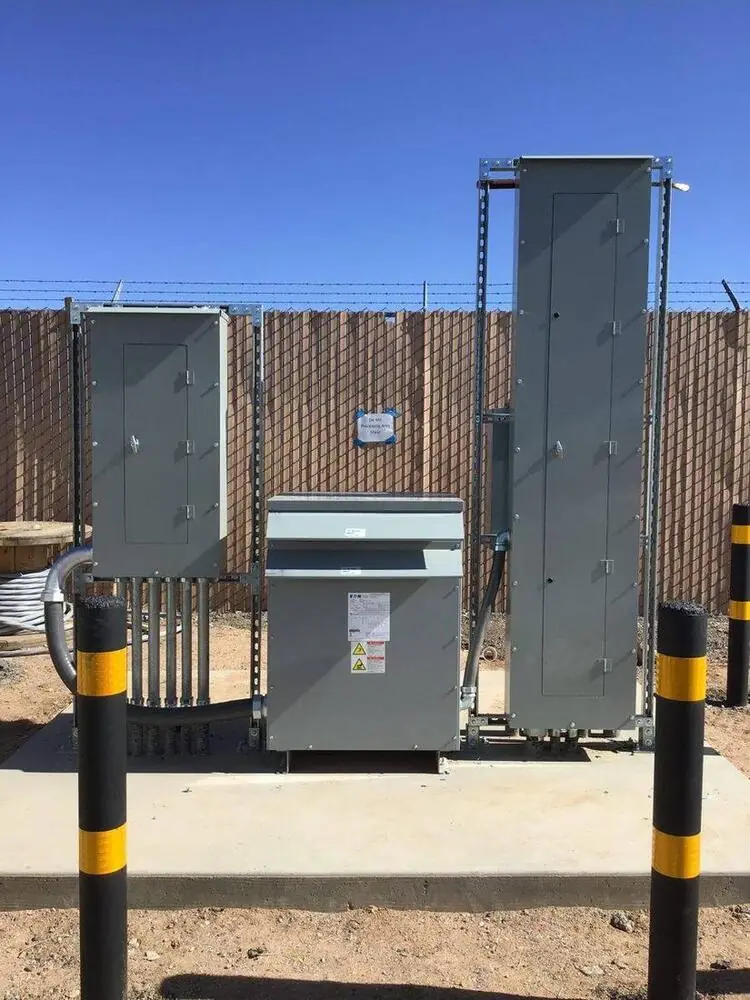
The distribution behind the motor — feeder capacity, overcurrent protection, and fault-current ratings verified before new load is added.

Conduit, cable, disconnects, and control wiring to the equipment, coordinated with the mechanical and equipment vendors before start-up.
FAQ
Yes — that is most of this work. We verify the feeder and protection can support the drive, install and wire it with shielded output cable and proper bonding, set and document the parameters, and commission it with your operators.
Often, on loads that run at partial demand much of the time — the energy savings on variable-torque loads like pumps and fans are real. On constant-load equipment the case is weaker. We would rather look at the load than sell a drive by default.
Yes. We install, bus, and wire MCCs and terminate the field connections, including starters, overload protection set to the motor nameplate, and the control wiring behind them.
We handle drive parameters, control wiring, interlocks, and commissioning. Where a machine runs on a PLC or a proprietary vendor control package, we coordinate with that vendor or your integrator and make the boundary explicit before start-up rather than during it.
Yes, and it usually is. Motor and drive work happens on equipment that is in service, so we plan around your production window — including nights and weekends when a line cannot stop during the week.
Yes. We troubleshoot and replace failed drives, starters, and control circuits, and we check what caused the failure — supply voltage, load, overload settings, or environment — instead of installing the same part to fail again.
Drivers: the horsepower and voltage, whether the existing starter and wiring can be reused, cable type (VFD-rated shielded cable matters and costs more), bypass and disconnect requirements, and integration with the building or plant controls. A drive that drops into an existing MCC bucket prices very differently from a wall-mount retrofit with new feeders. Send us the motor schedule or a nameplate photo and we'll quote it properly.
Related Services
One contractor carries the whole scope. See every service we self-perform.
Lighting controls, energy management and metering, motor controls, and commissioning.
Heavy distribution, machine and process power, motor controls, and high-bay lighting.
Panelboard, switchboard, and service-entrance upgrades with load calcs, TEP coordination, and phased shutdowns.
Equipment, ductwork, refrigerant piping, controls, ventilation, and start-up.
Send us the motor nameplate, the equipment list, or the drawing. We'll scope the power, the drives, and the downtime window in one bid.
Request a Bid Call (520) 308-6235