Services · Tucson, Arizona

Access Control & Security Camera Installation in Tucson, AZ

Access control and cameras fail on the details nobody bid: the door hardware that doesn't match the strike, the camera on a pole with no power, the lock that has to release when the fire alarm sounds. Arizona Electrical Solutions installs commercial security systems across Tucson as an electrical contractor — doors, cabling, head-end, and exterior power on one contract. Request a bid →

Security Systems

Doors, cameras, and the infrastructure behind both

We rough-in and install access control and video surveillance for commercial, industrial, institutional, and public facilities: readers, electric locks and strikes, request-to-exit devices, controllers and panels, intrusion detection, IP cameras, and the NVR head-end that stores it all. The cabling, pathways, and power are ours too, which is what keeps the system from stalling between trades.

This work is part of our special systems scope, and it shares a cable plant with our structured cabling work.

Doors

Access Control & Door Hardware

Card readers, electric strikes and magnetic locks, request-to-exit devices, power transfer hinges, and the controllers behind them — coordinated with the door and hardware suppliers so the openings actually function and stay code-compliant.

Special systems scope →
Cameras

Video Surveillance (CCTV)

IP and PoE camera systems with the pathways, cabling, and switching they depend on, plus the NVR and head-end room build-out — racks, grounding, and clean power included.

Structured cabling →
Exterior

Parking, Perimeter & Site Coverage

Cameras on poles and building exteriors where there is no power and no pathway yet — we trench, set the base, run the conduit, and feed it, under the same contract as the camera itself.

Parking lot lighting & poles →

Scoping It

What a security install really costs you

Hardware is the easy line item. These are the ones that decide whether the system works on day one:

Door count and hardware type

Every opening is its own small project: existing hardware, frame type, whether the door is in an egress path, and whether it needs a strike, a mag lock, or a power transfer hinge. Ten doors is ten different answers.

Life-safety interaction

Locked doors in an egress path have to release when the fire alarm sounds, and the AHJ inspects that. It is a code question first and a security question second — and it has to be coordinated with the fire alarm system, not bolted on afterward.

Network, PoE, and the head-end

Camera counts drive switch ports, PoE budget, storage, and bandwidth. Distance limits drive whether a run is copper or fiber. The head-end room needs power, grounding, and cooling that someone has to provide.

Exterior power and pathways

The camera locations that matter most — parking, perimeter, gates, yards — are usually the ones with no conduit within a hundred feet. Trenching, bases, and feeders often outweigh the hardware cost, and they belong in the bid up front.

Code

A locked door is a life-safety device

The fastest way to fail an inspection is to secure an opening the code says people must be able to leave through. Egress requirements govern how locked doors behave in an emergency: release on fire alarm, release on loss of power where required, request-to-exit that actually works, and hardware that lets someone out without special knowledge. The AHJ checks it.

We wire access control and fire alarm as one scope, so the interface between them is designed and tested rather than negotiated between two vendors on inspection day. See our fire alarm installation and life-safety work.

  • Egress and fire-alarm release coordinated with the AHJ, not assumed
  • Fail-safe and fail-secure decisions made per opening, in writing
  • Request-to-exit, door position, and tamper monitoring wired and verified
  • Magnetic door holders and smoke-barrier doors on the same plan
  • Testing witnessed at acceptance, with the fire alarm system

Platforms

Your platform, our infrastructure

Most owners already have a security platform, an integrator relationship, or an IT standard they have to live inside. We install and integrate the controllers, readers, cameras, and head-end for the platform you have chosen, and we build the infrastructure it runs on — cable, pathways, power, grounding, and the exterior work.

Ongoing software licensing and monitoring stay with the vendor you have selected. What we own is the part that is physically in the building, and the part that has to pass inspection.

  • Controllers, panels, and readers installed and integrated
  • Credential and schedule set-up coordinated with your administrator
  • IP cameras, PoE infrastructure, and NVR head-end build-out
  • Intrusion detection devices and panels
  • Coordination with your IT provider and existing security vendor

Self-Performed

From the ceiling to the parking lot

The reason to hire an electrical contractor for security work is the half of the job that is not security work.

Conduit and low-voltage pathway detail on a commercial project in Tucson, Arizona
Inside

Pathways, doors, and head-end

Conduit and cable to every reader and camera, terminations at the controller, and a head-end room with the power and grounding it needs.

Special systems →

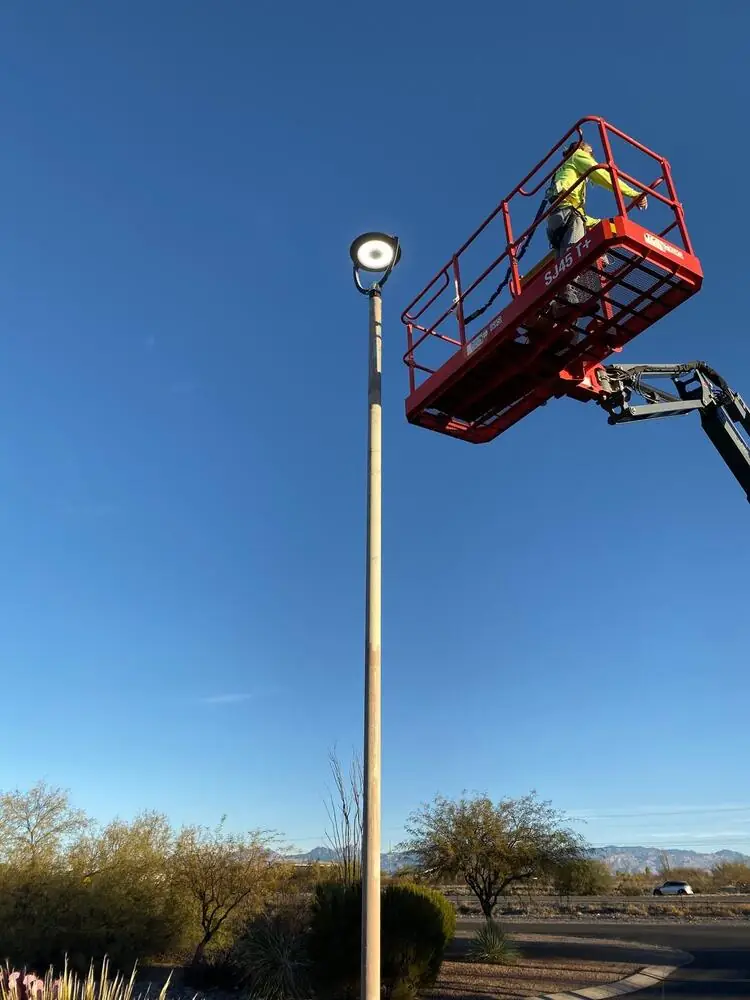
Electrician working from a boom lift on a pole-mounted exterior fixture in Tucson, Arizona
Outside

Poles, trenches, and exterior power

Camera locations that need a base, a trench, and a feeder before they need a camera — handled by our own crews and equipment.

Trenching & underground →

FAQ

Tucson access control and camera questions, answered

Do you install commercial access control systems?

Yes — readers, electric strikes and magnetic locks, request-to-exit devices, power transfer hinges, controllers, and the cabling that ties each door back to the panel. We coordinate the hardware with the door and frame suppliers so the openings function and stay code-compliant.

Do you provide the software platform and monitoring?

We install and integrate the platform you select, and we build the infrastructure it runs on. Software licensing and any monitoring service stay with that vendor — we don't resell a platform you'd then be locked into through us.

Do locked doors have to unlock when the fire alarm goes off?

In egress paths, the code governs how locked doors behave in an emergency, and the authority having jurisdiction inspects it. The right answer depends on the opening, the occupancy, and the hardware. Because we also install fire alarm, we design and test that interface as one system instead of coordinating it between two vendors on inspection day.

Can you add cameras to our parking lot?

Yes, including the parts that usually stop the project: trenching, pole bases, conduit, and power. We self-perform site work under our KA engineering license, so an exterior camera in a lot with no infrastructure is a normal job rather than a two-contractor problem.

Can you work with our existing IT provider or security vendor?

Routinely. We coordinate port counts, rack layout, labeling, IP addressing hand-off, and cutover scheduling with whoever manages your network and platform.

Do you install intrusion detection too?

Yes — motion, door, and glass-break sensors and the panels that monitor them, installed alongside the access control and camera infrastructure.

Related Services

Work that usually comes with this one

One contractor carries the whole scope. See every service we self-perform.

Related Service

Special Systems

Structured cabling, access control, video surveillance, AV, and paging.

Related Service

Life-Safety Systems

Fire alarm, emergency power, egress lighting, and AHJ sign-off.

Related Service

Parking Lot Lighting

Photometric design, LED conversions, pole repair, bases, and feeders.

Securing doors or covering a site?

Send us a door schedule, a site plan, or a list of the blind spots. We'll scope the hardware, the cable, and the exterior work in one bid.

Request a Bid Call (520) 308-6235