Engineered In-House
Demand load calculations, single-lines, load management, and permit-ready documents from our own in-house electrical engineering team — the same group that designs our power distribution work.
Electrical engineering →Level 2 and DC fast charging for workplaces, fleets, retail, and multifamily — engineered in-house, trenched and wired by our own crews, with the TEP coordination handled. Request a bid →
Manufacturer Certified
Arizona Electrical Solutions is a Tesla Certified Installer, vetted by Tesla and listed in their installer directory. We install Tesla Wall Connectors and Universal Wall Connectors for workplaces, multifamily, and homes — along with the J1772 and NACS hardware the rest of the parking lot plugs into.
The badge matters for what it signals: manufacturer-vetted charging installation from the same licensed crews that build commercial electrical services and site lighting and infrastructure across Tucson every day.
Commercial EV Infrastructure
On a commercial property, EV charging isn’t an appliance install — it’s a load calculation, a possible service change, a utility application, and a trench across the parking lot before the chargers ever arrive. Arizona Electrical Solutions is a Tucson-based commercial design-build contractor: our engineers design the system, our own CR-11 electrical crews build and energize it, and our owned Cat® fleet digs it — one team, one contract, one schedule.
The chargers are usually the cheapest part of the project — the value is won or lost in the capacity study, the utility coordination, and the dirt.
Demand load calculations, single-lines, load management, and permit-ready documents from our own in-house electrical engineering team — the same group that designs our power distribution work.
Electrical engineering →Panels, feeders, charging circuits, and the chargers themselves, installed and energized by the same firm that drew the design.
Solar, storage & EV charging →Saw-cutting, trenching, conduit, backfill, and restoration out to the parking stalls — self-performed with our owned Cat® equipment and certified operators.
Underground & heavy equipment →Level 2 vs. DC Fast
The right answer depends on how long vehicles sit — and how much power the site can spare.
Level 2 chargers run on 208 or 240 volts and add meaningful range over hours — which is how most commercial parking behaves: employees park for a shift, residents overnight, guests until morning. For workplaces, multifamily, hotels, and retail, Level 2 delivers the charging drivers actually use at a fraction of the electrical demand — often on capacity the building already has.
DC fast chargers deliver a much faster charge at far higher power — the right tool for fleets on a turnaround and for retail or corridor sites competing on speed. It routinely triggers new switchgear, a dedicated transformer, or an upgraded utility service, so the capacity and utility questions come first.
Where It Applies
Most Tucson sites land on Level 2, sometimes with a few DC fast positions. We design and install both, for:
The Capacity Question
Every project should start with the same question: what can the existing panel and service actually support? We run the demand load calculation against the real system — not a rule of thumb — before anyone orders chargers.
Load management is often the difference between a panel circuit and a utility service upgrade: managed charging shares the available amperage, so a site can add positions without overbuilding the service. When an upgrade is the right answer, our engineers design the new service and distribution and our crews build it — the same in-house engineering team that sized the load draws the single-line the utility sees.
Utility Coordination
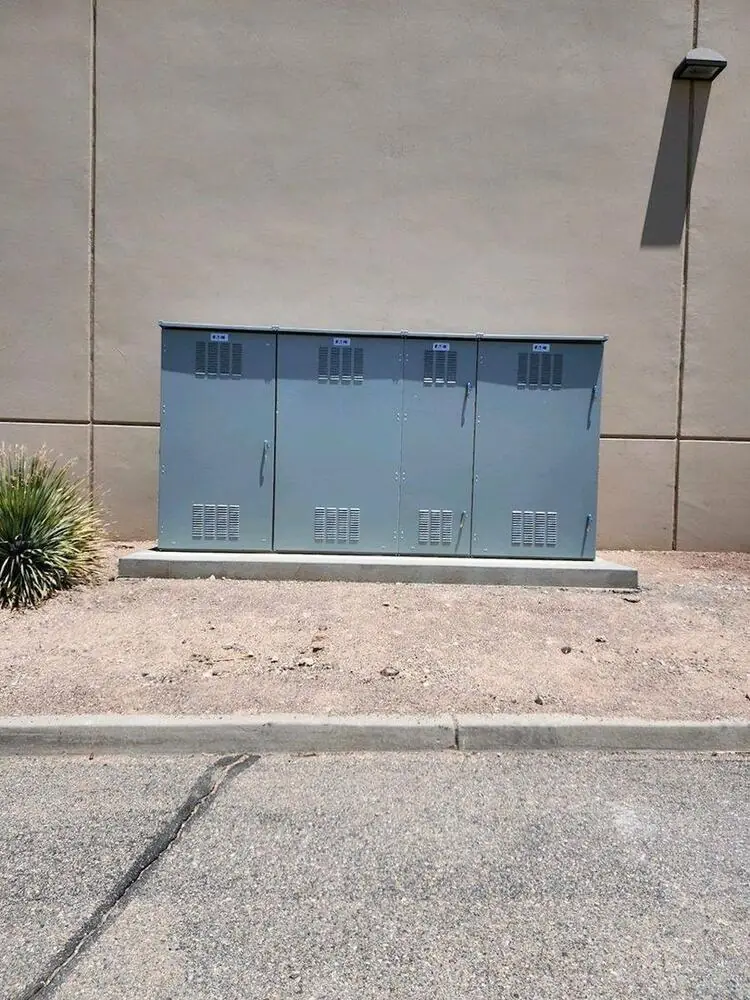
When charging pushes past what the existing service can carry, the project runs through the serving utility. We prepare and carry the application with Tucson Electric Power — or Trico Electric Cooperative in the areas it serves — design the service entrance and metering to the utility’s specification, and settle transformer and point-of-connection details before construction.
Under TEP’s service rules, the customer’s contractor typically provides the trenching, conduit, backfill, and restoration while TEP furnishes and owns the service cable — exactly the scope we self-perform. We work with these requirements daily and maintain a TEP standards reference hub our crews and other contractors use.
Make-Ready & Phasing
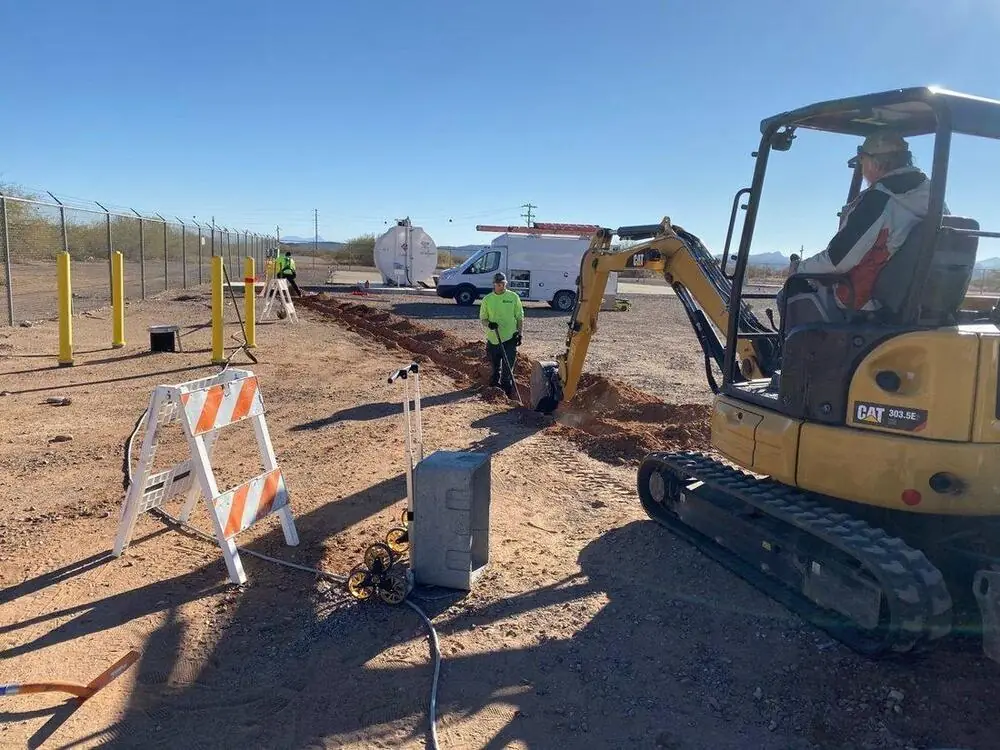
The most expensive distance in commercial EV charging is usually the run between the electrical room and the parking stall: saw-cutting, trenching, pull boxes, backfill, and restoration — and paying for it twice is the expensive mistake.
A make-ready design installs the panel capacity, conduit, and pull boxes for the full build-out while energizing only the chargers you need today — when demand grows, the next row is an electrical task, not more pavement work. Because our operators and electricians run on one coordinated underground schedule, the trench is open when the conduit crew is ready and restored before the lot reopens.
Federal and utility incentive programs for commercial EV infrastructure change frequently — programs open, close, and revise their terms. Rather than build your budget around a program that may have moved, we confirm what is currently available during design and factor it into the recommendation.
Fleet & Depot Charging
The most common mistake in fleet electrification is buying charging speed the yard never uses. The design question isn’t how fast a charger can fill a battery — it’s how long the vehicles actually sit. A truck that parks at 6:00 PM and rolls at 6:00 AM has twelve hours of dwell, and a modest Level 2 circuit fills it overnight at a fraction of the electrical demand, equipment cost, and demand charges of DC fast charging. For most Tucson depots, overnight Level 2 across the yard — with a DC fast position or two held for mid-shift top-ups and the exceptions — beats a row of fast chargers on every number that shows up on the utility bill.
A depot’s chargers rarely all need full power at once, and managed charging turns that fact into capacity: the system staggers and shares amperage so the total draw stays under the service rating while the schedule still ends with every vehicle full. Done right, load management is the difference between electrifying on the existing service and buying new switchgear — and it keeps the demand charges billed against your monthly peak from eating the fuel savings. We start from a power study of the actual service, the metering history, and the route schedule before anyone picks hardware.
Fleets electrify in stages — a few vehicles this year, more on the next replacement cycle — and the infrastructure shouldn’t be rebuilt each time. We size the panel capacity, conduit runs, and pull boxes for the end-state fleet while installing only the chargers today’s vehicles need, so each expansion is an electrical task instead of another round of saw-cutting across the yard. And when the end-state load is genuinely large — depot-scale charging can rival the rest of the facility — we open the conversation with TEP early, because transformer and service upgrades move on the utility’s timeline, not the vehicle delivery schedule.
EVSE Maintenance & Repair
A dead charger costs more than no charger: drivers flag it on the network apps, tenants complain to the property manager, and a fleet vehicle that didn’t charge overnight is a route that doesn’t run. We maintain and repair commercial charging stations across Tucson — our installs and other contractors’ — with service visits scheduled during our regular weekday hours and planned around your parking and operations. It’s the same planned-maintenance discipline we bring to commercial electrical maintenance across the rest of the building.
When a station drops offline or faults, we work the problem in order: verify supply voltage and the branch circuit, read the fault codes, exercise the ground-fault protection, and isolate whether the failure is electrical, hardware, or communications — so the fix is the right one, not a guess.
Connectors and cables are the parts drivers touch a dozen times a day, and they fail first — dropped handles, latch wear, pin damage, cables run over or left on the pavement. We inspect, replace connector assemblies and cable sets, and repair or upgrade cable-management hardware so the next drop doesn’t total the handle.
A surprising share of “broken” chargers are actually communication problems — a dropped cellular or network connection, a stalled firmware update, or an OCPP handshake failure between the charger and its network back end. We separate the connectivity faults from the hardware faults, restore the connection, and coordinate with the network operator when the problem is on their side.
For hardware still under manufacturer warranty, we diagnose the failure and document it the way the claim requires, so the replacement part ships instead of the claim bouncing. Out of warranty, we repair what is economically repairable as licensed electricians — and tell you plainly when replacement is the cheaper path.
Desert Duty Cycle
Charging equipment in Tucson works in conditions its spec sheet calls extreme. Summer pavement pushes enclosure temperatures well past the 110°F design days, and many chargers derate output or shut down in the heat; sun-side screens and plastics fail years early; UV chalks and embrittles cable jackets; and monsoon dust finds its way into connector pins, vent filters, and enclosure gaskets every July and August. A charger that would idle along for years in a mild climate needs a real preventive cadence here.
We recommend scheduled preventive inspections — at least annually for typical duty, more often for fleet and high-use stations — performed as planned daytime visits during our regular weekday hours, so the stalls come back into service the same day.
FAQ
Not always. Many Tucson sites can add Level 2 charging on existing capacity, and load management lets more chargers share the available amperage on the same service. We start with a demand load calculation against the actual panel and service; if an upgrade is genuinely needed — as DC fast charging often triggers — we design it and coordinate the new service with TEP or Trico ourselves.
Level 2 chargers run on 208 or 240 volts and add meaningful range over hours — a fit for workplaces, multifamily, hotels, and retail where vehicles dwell. DC fast chargers charge much faster for fleets and quick-turnaround sites, but at far higher power — often enough to require new switchgear or an upgraded utility service. Most commercial sites land on Level 2, sometimes with a few DC fast positions.
It depends on the site more than the charger. The main cost drivers are available electrical capacity, the distance from the electrical room to the stalls, whether the route runs through landscape or cut asphalt, charger count and power level, and whether the utility service needs an upgrade. Because we self-perform the engineering, the electrical, and the trenching, we price the whole scope in one bid — send us a site plan.
We do, with our own crews and owned Cat equipment. Under TEP's service rules the customer's contractor typically provides the trenching, conduit, backfill, and surface restoration — scope we self-perform daily, on one schedule with our electricians.
Federal and utility incentive programs for commercial EV infrastructure change frequently — programs open, close, and revise their terms. We confirm what is currently available during design and factor it into the recommendation.
Yes — a phased build-out is usually the smart way to do it. A make-ready design installs the capacity, conduit, and pull boxes for the full build-out while energizing only what you need today, so adding chargers later is an electrical task instead of another round of trenching.
Yes. Arizona Electrical Solutions is a Tesla Certified Installer, listed in Tesla's own installer directory. We install Tesla Wall Connectors and Universal Wall Connectors alongside J1772 and networked commercial charging hardware — backed by the same crews that handle the trenching, the service capacity, and the TEP coordination.
Yes. We troubleshoot and repair commercial charging stations — connector and cable replacement, breaker and wiring faults, and network or OCPP communication problems — and we document hardware failures the way manufacturer warranty claims require. Repairs and preventive inspections are planned service visits scheduled during our regular weekday hours, worked around your parking and operations.
At least annually for typical duty, and more often for fleet and high-use stations. The desert accelerates wear — summer heat stresses electronics and can derate charger output, monsoon dust packs into connector pins and enclosure filters, and UV degrades cable jackets — so a Tucson inspection should cover termination torque checks, connector and cable condition, ground-fault trip testing, and enclosure cleaning.
For most depots, overnight Level 2 wins. Vehicles that sit for eight to twelve hours leave full on modest power at far lower equipment, demand-charge, and service-capacity cost, with a DC fast position or two reserved for mid-shift top-ups. The math changes for fleets on tight turnarounds — which is why we start from the route schedule and a load study rather than the charger catalog.
Send us the site plan or just the goal — we’ll check the service capacity and the utility path before anyone orders chargers.
Request a Bid Call (520) 308-6235