Pickleball & Tennis Court LED Lighting Retrofit

An LED retrofit of the court lighting at an RV resort community in Tucson. New heads went up on the resort's existing poles, so the pickleball and tennis courts got modern light without new poles, new foundations, or a trench across finished hardscape.

Location

Private RV resort community, Tucson, Arizona

Scope

LED retrofit of the pickleball, tennis and adjacent amenity lighting

Approach

New heads on the existing poles — no new poles, foundations or trenching

Setting

Active resort — courts and walkways stayed in use around the work

Scope of Work

A retrofit, not a rebuild

The resort already had poles in the right places. The fixtures on them were what needed to change. Reusing the poles and the existing circuits kept this job out of the ground entirely — nothing to pour, nothing to trench, and no courts closed waiting on concrete to cure.

Survey & fixture selection

  • Poles and circuits first — confirmed what the existing poles, arms and branch circuits could carry before anything was ordered
  • Heads matched to the mount — flood-style heads on the straight court poles, area heads on the existing curved arms
  • Aimed for play — heads set and tilted to the court surface rather than spilling across the grounds
Working an occupied resort

  • Lift access — pole work reached from a boom lift staged on the hardscape, keeping equipment off the court surfaces
  • Live equipment overhead — several poles also carry resort communications and PA gear that stayed in service throughout
  • Daily turnover — courts handed back to residents and guests at the end of each shift

Electrical scope

  • Fixture changeout — old heads removed, LED heads mounted, terminated and weather-sealed at the pole
  • Circuits and controls — existing branch circuits and switching reused and verified rather than replaced
  • Verified at the pole — each head checked under power before the lift moved on

What it covers

  • Pickleball and tennis — the primary play surfaces and the poles around them
  • Adjacent amenities — shuffleboard, seating and the observation-tower area lit off the same poles
  • One fixture family — a consistent head across the complex instead of a patchwork of leftovers

Sequence

How the retrofit ran

A retrofit lives or dies on what you find on the pole. The order below is what kept this one from turning into a pole-replacement project.

Step 1

Survey what's already up there

Every pole walked before ordering: mounting style, arm condition, what else was hanging on it, and what the branch circuit was feeding. That is what decided which head went where.

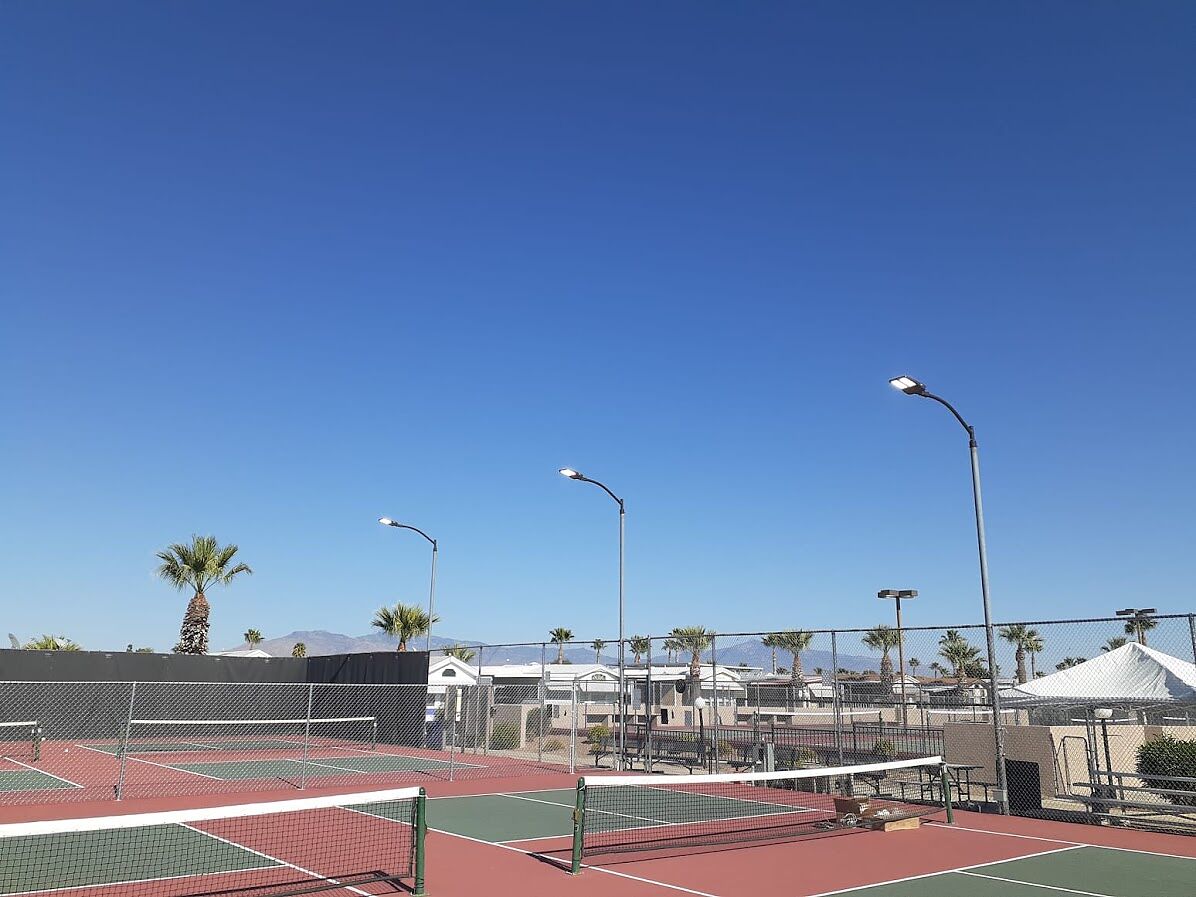
Existing light poles with new LED heads above the tennis and pickleball courts at an RV resort in Tucson, Arizona
Step 2

Change out the heads

Old fixtures off and LED heads on, worked from a boom lift staged on the hardscape. The poles carrying resort communications and PA equipment were worked around live — that gear never came down.

Boom lift positioned beside resort light poles during an LED fixture changeout at an RV resort in Tucson, Arizona
Step 3

Aim it and hand it back

Each head tilted to the play surface and checked under power, then the courts went straight back into use — no concrete, no restoration, nothing left fenced off overnight.

New LED heads on poles flanking the covered observation tower between the courts at an RV resort in Tucson, Arizona

Photos

On site

New heads, existing poles, and a resort that stayed open the whole time.

LED court lighting on existing poles above the tennis and pickleball courts at an RV resort in Tucson, Arizona
New LED heads across the courts
Close view of a new LED flood head mounted on an existing court light pole at an RV resort in Tucson, Arizona
LED head on an existing pole
Boom lift staged beside resort light poles during the LED fixture changeout, with poles also carrying communications and PA equipment
Changeout from a boom lift
Two poles with new LED heads flanking the covered observation tower at an RV resort in Tucson, Arizona
Lighting at the observation tower

Buyer's Guide

Thinking about lighting for your own courts?

This project is the pattern for most court-lighting decisions in Tucson. Here is what actually drives a sports-court lighting job — pickleball, tennis, or multi-court — before anyone quotes you a fixture.

How much light do courts actually need?

Recreational outdoor courts are commonly lit to around 30 footcandles, with competitive and club-level play targeting more — and uniformity matters as much as the number, because a bright center with dark corners plays worse than an evenly lit court at a lower level. LED heads make both easier: more lumens per watt, and optics that put the light on the court instead of scattering it.

Dark-sky rules are real in Tucson

Tucson and Pima County enforce an outdoor lighting code written to protect the dark sky — full-cutoff fixtures, warm color temperatures, and limits on uplight and spill. Court lighting can absolutely comply: shielded LED heads aimed down at the surface, on poles no taller than the throw requires. We design to the code instead of arguing with it.

Retrofit or new poles?

The expensive part of court lighting is the poles, foundations, and trenching — not the fixtures. If the existing poles are structurally sound and positioned where the light needs to come from, new LED heads on old poles delivers most of the benefit at a fraction of the cost, with no concrete and no closed courts. When poles are rotted, undersized, or in the wrong places, we say so — and we self-perform the trenching and foundations that new poles need.

Glare is the complaint that matters

On a pickleball court the ball spends half its life overhead. Fixture optics, mounting height, and aiming angles decide whether players are tracking a lob or staring into a floodlight — and whether the neighbors see a lit court or a glare bomb. Aiming and shielding get engineered here, not eyeballed from the lift.

FAQ

Sports court lighting questions, answered

Can you light courts without new poles?

Often, yes. If the existing poles are sound and well-placed, new LED heads with the right optics deliver most of the improvement at a fraction of the cost — that is exactly what this project did. A site walk tells us quickly whether your poles can carry it.

Do LED court lights comply with Tucson's dark-sky ordinance?

Yes, when they're specified and aimed correctly. Tucson and Pima County's outdoor lighting code requires full-cutoff, low-uplight fixtures at warm color temperatures — modern shielded LED sports optics meet it while putting more usable light on the court than the old floods they replace.

How long does a court lighting retrofit take?

A heads-on-existing-poles retrofit is typically measured in days, not weeks — and courts come back into service as each pole is finished, not at the end of the job. New poles add foundations, inspections, and concrete cure time to the schedule.

What does court lighting cost?

It swings on one question: are the poles staying? Fixture count, mounting height, controls, and whether trenching or new foundations are involved drive the rest. Tell us what you have and what you play, and we'll come back with both numbers — the retrofit and the rebuild — priced honestly.

The Services Behind It

Need this kind of work on your project?

Every scope on this job is a service we self-perform. Start with the pages below, or tell us about your project.

Why a Retrofit

Better light without opening the ground

The expensive part of court lighting is almost never the fixture — it is the poles, the foundations and the trench. When the existing poles are sound and in the right places, the right answer is to leave them alone. That is a judgement call that needs someone who does both the electrical and the civil work, because the alternative is a contractor whose only tool is a new pole base.

Request a Bid
  • Existing poles, arms and circuits reused — no foundations, no trenching, no hardscape restoration.
  • Licensed electrical in-house for the changeout, terminations and circuit verification.
  • Boom-lift work staged off the courts, so play surfaces were never used as a laydown yard.
  • Communications and PA equipment sharing the poles stayed live through the whole retrofit.
  • Courts returned to service at the end of each shift instead of at the end of the job.

Have courts, a lot, or a site that needs better light?

Sports courts, parking lots, RV resorts, HOA common areas — we will tell you honestly whether it is a fixture swap or whether the poles have to come out, and price it either way.

Start a Project Inquiry