Ground-up construction
Every new building or pad site needs its own service, transformer capacity, and point of connection — and the application belongs early in design, not after the slab is poured.
A new commercial electric service from Tucson Electric Power follows a published process: apply, TEP designs, your contractor builds the civil and metering work to TEP's standards, TEP inspects, TEP energizes. Here's how it works — and where schedules slip. Request a bid →
The Short Answer
TEP's rules for new and upgraded services live in its Electric Service Requirements (ESR) book, republished annually and revised through the year, and the process itself is described on TEP's construction applications page and construction services FAQs. In short: you apply; TEP designs and sets the point of connection; your contractor builds the trench, conduit, pads, and metering equipment to TEP's spec; TEP inspects, then installs its cable, sets the meter, and releases the service.
This page summarizes TEP's published guidance; TEP's documents and service planners are always the final word. Our TEP standards hub links to the current official documents and the SR-452 approved equipment list.
When It Applies
Anything that changes how much power a site needs, or where it enters the building, usually puts you into TEP's new-service process.
Every new building or pad site needs its own service, transformer capacity, and point of connection — and the application belongs early in design, not after the slab is poured.
EV charging, added HVAC, or process equipment can push a facility past its service rating. Service upgrades and re-feeds run through largely the same TEP process.
Relocating a service, converting overhead to underground, or splitting one service into several for a multi-tenant site all require TEP design and a new agreement.
Single-phase to three-phase, a new service voltage, or crossing into CT metering changes the equipment TEP requires.
Step by Step
TEP's construction services FAQs describe four steps — application, design, customer construction, TEP construction.
Submit TEP's application with the service type and size, load information, site plan, required date, and building permit number. Our in-house engineering prepares the load calculations.
A TEP designer or field technician meets on site and produces a preliminary design — point of connection, transformer location, route — for your approval.
TEP issues final design and contracts, and any deposits or easements are secured — the customer approves both, and easement delays stall everything behind them.
The contractor builds the trench, conduit, pads, and metering equipment to TEP's standards — with gear from TEP's approved metering equipment list (SR-452) and Arizona 811 locates before digging.
TEP inspects the customer work — meter sockets, connections, trenches, conduit, address labeling — and requires AHJ clearance, executed agreements, and paid fees before its crews mobilize.
TEP installs and terminates its service cable, completes the transformer work, sets the meter, and releases the service.
Division of Work
TEP's Rules and Regulations on service lines (Rule 906) draw the line clearly — and most of the schedule lives on the customer's side of it.
Schedule Risk
The long poles on a new service usually aren't labor — they're TEP's design queue and the equipment. Switchgear, switchboards, and CT cabinets carry lead times measured in months, and transformer availability has been an industry-wide constraint for years. Gear ordered late can leave a finished building sitting dark.
The defense is sequencing: apply early, release long-lead gear when the design is approved, and run the trench and duct bank in parallel. Our electrical engineers size the service and flag long-lead equipment at design — the same team that builds it.
The Design-Build Advantage
Most projects split the TEP scope across an engineer, an excavation sub, and an electrician — three schedules, one utility waiting. We hold it in one contract: our engineers prepare the load calculations and application, our crews and owned Cat fleet dig the trench and build the duct bank, and our electricians set the pads, install TEP-approved metering gear, and carry the service through inspection and release — backed by four Arizona ROC licenses. When TEP calls, one team answers — no sub waiting on a sub.
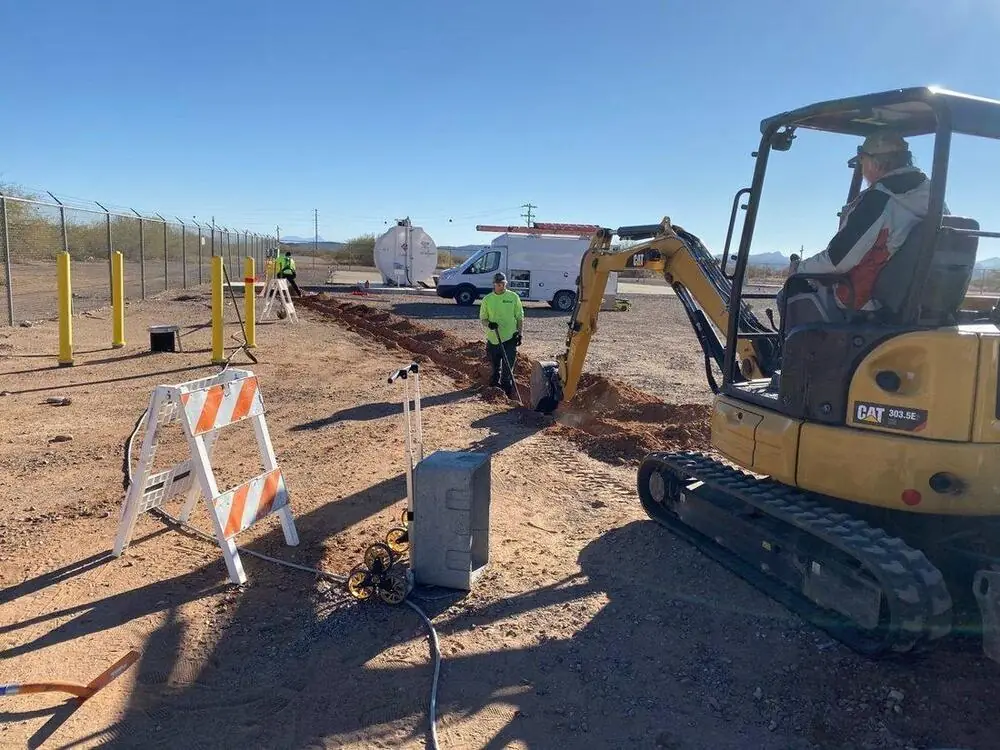
Trench, conduit, pads, and metering-ready gear by the firm that pulls the wire.
FAQ
Through TEP's construction application — online or with a New Service Representative — with the service address, service type and size, date needed, load information, a site plan, and building permit number. Apply early: TEP's design precedes civil work. We prepare and submit it, with in-house load calculations, as part of our scope.
Under TEP's published rules, the customer's contractor typically provides the trench, conduit, backfill, and surface restoration to TEP's specifications; TEP furnishes, installs, and owns the underground service cable. We self-perform that trenching, conduit, and duct bank work with our own crews and owned Cat equipment, with Arizona 811 locates before we dig.
It varies; TEP does not publish a fixed timeline. The main drivers are TEP's design queue, easements, transformer and switchgear procurement, the construction itself, and inspection corrections. Applying early, ordering long-lead gear at design approval, and passing inspection the first time are the levers that shorten it.
TEP's construction FAQs list inspections of meter sockets, connections, trenches, conduit, and address labeling — plus final clearance from the permitting agency, executed agreements, and paid fees before TEP crews complete the installation. We build to the current TEP standard sheets from the start.
There's no standard price. The drivers: service size and voltage, distance from TEP's facilities and any line extension, trench length, easements, self-contained versus CT metering, and the switchgear the building needs. TEP's charges are set by its rules and design. Send us the site plan and expected load for a real bid.
TEP does not serve the entire metro — Trico Electric Cooperative serves much of Marana, Corona de Tucson, and other outlying areas, with its own service requirements. Confirm the serving utility before designing or pricing the service. We build on both TEP and Trico systems.
Send the site plan and the expected load. We'll handle the application, the utility coordination, and the dirt.
Request a Bid Call (520) 308-6235